RePEc in January 2020

February 4, 2020

We are off to a good start with already healthy traffic on our reporting services. we counted 502,431 file downloads and 3,597,790 abstract views during the year’s first month. We welcome four new archives: Federal University of Pernambuco, PLOS Journals, Technium Science, Cracow University of Economics. Finally, we reached the following milestones:

7,500,000 cumulative downloads though NEP
2,000,000 indexed journal articles
800,000 working papers available online
600 RePEc-wide H-Index


Using the RePEc search engines

January 24, 2020

RePEc seeks to enhance the dissemination of economics research. There are many ways to do this, and an important one is to provide search engines for literature searches. This post discusses two on them. Searching on RePEc provides many advantages over searching with your favorite web search engine: search are naturally limited to academic economics content and can be configured in many ways because RePEc has much more detailed information.

EconPapers

EconPapers is a popular site that allows to discover all RePEc content through browsing or searching. The advanced search page highlights all the fields that can be used to narrow the search: date, field (through JEL code), document type, online availability, and language. One can differentiate the search terms across author, keyword, and abstract fields. Boolean searches with logical operators are available and wild cards can be used on word stems. It is also possible to search within NEP reports if one is looking for a working paper within a specific field. A help page provide further hints and tricks for an efficient search.

EconPapers displays search results in a convenient way, showing the listing in a box and one can click on individual items to see the full content. Results can be sorted by date, relevance, or alphabetically by title.

IDEAS

IDEAS is another popular site with functionalities similar to EconPapers. Its search engine was recently improved. It offers similar fielded search with a few tricks that differentiate it from EconPapers. For example, word stemming is algorithmic, thus wildcards are not needed. Synonyms are used natively, reducing the need to think about them. One can search for AuthorOne AuthorTwo (Year), the typical way one cites in economics, and a match will most likely be displayed. A search from the listing of a journal of a working paper series limits the results to that serials. The same feature is available for JEL codes. The search page also offers separate searches for other item types in RePEc, such as registered authors and institutions.

Search results can be sorted by citation counts or a combination of criteria. In addition, on can save a search to MyIDEAS, which allows to go back to it easily later or get weekly email alerts about new search results. Individual search results can also be saved to one’s personal MyIDEAS bibliography with one click.


RePEc in 2019

January 4, 2020

2019 has been an interesting year. Indeed, while traffic has been on a long decline for the set of reporting RePEc services, there has been a major turnaround in 2019. For those services, we counted 5,821,298 full text downloads and 28,629,161 abstract views, numbers that are the highest since 2017 and 2013 respectively. We will see whether this trend will continue in 2020. A contributing factor may be the continuous improvements of the websites that drive most of this traffic. This blog will talk over the next year about how RePEc services distinguish themselves from other more generic services and thus are particularly useful for economists and the general public interested in economics.

Of course, this growth of traffic was likely also fuelled by an increase in content indexed by RePEc. We can highlight the following numbers:
87 new RePEc archives,
66,000 new working papers, with 200 new working paper series,
167,000 new journal articles, with 400 new journals,
for a total of almost a quarter million newly indexed works,
2,600 newly registered authors,
and 3,200 NEP reports.

Looking forward to 2020!


RePEc in December 2019

January 4, 2020

The big news of the month is that there are now over 3 million works indexed in RePEc. This achievement would never have been reached without the help of our over 2,000 RePEc archive maintainers. The latest ones to join this group were: Junior Scientific Researcher (Romania), Croatian Economic Association. We also counted 507,039 file downloads and 2,906,575 abstract views, Finally, the full list of the milestones we reached over last month is:

3,000,000 works listed
500,000 working papers with references
8,000 ranked institutions


3 million items indexed in RePEc

December 12, 2019

A few day ago, RePEc reached a major milestone by indexing over 3 million research items: journal articles, working papers (pre-prints), books, book chapters, and software components. The graph below, taken from the LogEc website and not yet featuring the December 2019 numbers, shows the evolution of the RePEc index since its start in 1997 (click on it to view a larger image).

This graph shows that RePEc content continues to grow relentlessly. With all major publishers participating in RePEc by now, the growth now comes much less from new archives but rather from the continuous growth within the over 2000 participating RePEc archives featuring over 5000 working paper series, 3500 journals, and more. As economists would say, we have shifted from the extensive margin to the intensive margin, which can explain a slight decrease in the growth rate over the last few years.

The first statistics at the end of January 1998 indicate an index with 51,984 entries. The first million was reached in January 2011, the second in December 2017, and the third now in December 2019. Only two years for the last million!

If your publishers or your local academic or policy institution still does not participate in RePEc, it can join by following these instructions, or you can upload your works as an individual contributor at MPRA.


RePEc in November 2019

December 4, 2019

November was remarkable for a significant push in new content. 10,000 new working papers and 32,000 new journal articles in a single month. In part, this was thanks to our new participating archives: Global Regional Review, Center for Open Science, Science Publications, Sapienza University of Rome. Also, we counted 607,140 file downloads and 3,805,447 abstract views, the latter being a record for a single month.

Finally, the milestones we reached:

100,000 book chapter abstract views in a single month
100,000 book abstract views in a single month (was in October 2019)


RePEc in October 2019

November 4, 2019

What is new for October? For the first time ever, we have no new RePEc archives to announce. But have now worries, there are already two new ones in November. We had a very good month for traffic, with 588,930 file downloads and 3,400,998 abstract views. And we passed the following milestones:

70,000 NEP report issues created.
1,000 first NEP reports with that many issues


How RePEc helps with Open Access in Economics

October 24, 2019

From 21 to 27 October 2019, the Open Access Week is raising awareness about free access to scholarly research. This year’s theme is “Open for Whom? Equity in Open Knowledge,” which fits nicely in the mission of RePEc. Indeed, the goal of RePEc is to enhance the dissemination of research in the field of economics, in particular through the democratization of access to economic research both for the authors and the readers. The core aspect of RePEc is an open bibliography that allows various “RePEc services” to leverage the metadata about publication in various ways, such as email lists, search engines, organized listings, and more. For an overview of some of the services, see the RePEc home page.

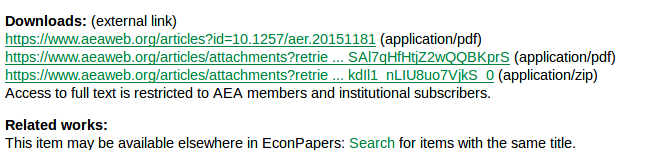
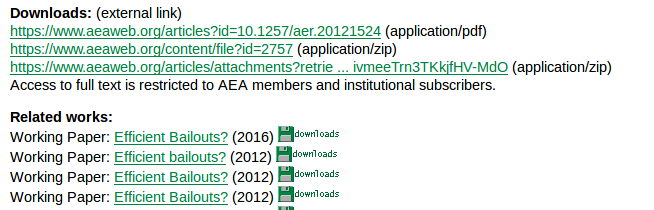
RePEc facilitates open access is several ways. First, all publishers are on equal footing in terms of getting their publication material indexed in RePEc. It is upon them to follow the instructions and maintain their holdings. Second, the metadata makes the distinction between gated and free access, which some RePEc services exploit in the display of the research. For example, on EconPapers, information about download restrictions is listed next to the download link. In the absence of such language, it is assumed that the article is openly accessible (click on images to see them better):
.

Note in the first case a prompt to search for other (open) versions, more on this later. On IDEAS, similar language is present in case of gated access:
In addition, the listing of articles on IDEAS for a journal also displays an icon about the download status. In this case, within the same issue of a journal, the first article is open, the second gated, and the third not available online.

Open access penetration in economics journals is comparatively low, though. Indeed, there is likely less need for open access due to a large number of pre-prints, called working papers or discussion papers in economics. In fact, RePEc and it predecessor projects were launched precisely to disseminate working papers, and over 900,000 of them are currently indexed. Working papers are typically in open access, with few exceptions, and it is then not surprising that when both working paper and article versions are available, the working paper is downloaded many more times.

Matching different versions of the same work is a difficult undertaking, especially as many different works have the same title. We leverage the fact that about half the indexed works are written by someone registered in the RePEc Author Service. Then if the same author has several works with a very similar title, we deem them to be different versions of the same research. And if the title changed, authors can add a link using this form.

This information in then leveraged on RePEc services. For example, on EconPapers, the working paper versions are listed right under the download link of the article (and vice-versa).
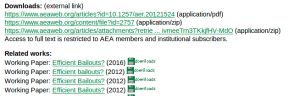
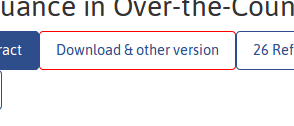
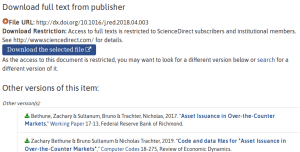
On IDEAS, there are multiple prompts about the availability of different versions. On the article listing of the journal, a green “WP” appears when a working paper version is available. Then, on the abstract page of the article, the pill for download tab mentions it again. And, finally, the working paper versions are listed right under the download link (and the article version on the working paper download link).

.
.
Working papers are pretty much where the frontier of research is in economics. Journal articles are in this respect a historical record of where the frontier was a few years prior, given the publication delays. This is why the email alerting service of RePEc, NEP, notifies about new working papers, but not about articles. Universities and policy institutions are welcome to index their working papers in RePEc, it is free and follows the same instructions as for journals. And if an author does not have access to a local RePEc-indexed working papers series, they can upload their works at MPRA.


RePEc in September 2019

October 7, 2019

Short but sweet post regarding last month. We welcomed a small group of newly participating RePEc archives: Juniper Publishers, Journal of Financial Analysis, Journal of Economic Impact, Università degli studi di Pavia. We counted 453,439 file downloads and 2,588,056 abstract views. And we passed the following milestones:

15,000 cited books


What a RePEc Author Service account is good for

October 3, 2019

A little more than 20 years ago, the RePEc Author Service was launched (then under the name of HoPEc) as a self-registering service. This allows economists to create an account with RePEc. What for? This blog post is trying to enumerate all the uses of this account that were created since.

Unique identification

Before all the other identification services for academics and researchers, we created the RePEc short-ID, a unique identifier attached to a registered person. This identifier is used throughout RePEc much in the same way other objects are identified through handles: series, journals, papers, articles, institutions, archives… They can references each other, they can be used to draw statistics (including rankings). The use is not limited to RePEc: we see it for example in Wikipedia, Wikidata, and elsewhere.

Research record

Creating an account in the RePEc Author Service also allows an economist to establish and maintain a record of their scholarly output. The RePEc Author Service tries to match works indexed in RePEc with name variations provided by the author and asks the author to validate the potential matches. Not only does this establish a research record for the person, it also allows to disambiguate homonyms or authors with the same initials and last names. The research records are public and used by other RePEc services like EconPapers and IDEAS. The RePEc Author Service also helps in the discovery of citations for CitEc, which also maintains author pages.

The records from the RePEc Author Service facilitate other data improvements in RePEc. For example, affiliation data is leveraged in EDIRC, the directory of economics institutions to provide member lists. In addition, if several works within an author’s record have very similar titles, we deem them to be different versions of each other and we can link across them in bibliographic records.

Access to personalized services

Everything on RePEc is available for free and without registration because we believe this is how you provide the widest dissemination of research. Yet, there are some enhanced services that are impossible without providing personalization. The following examples do not require one to be an author, only to have an account with the RePEc Author Service:


  • MyIDEAS allows to create a personalize bibliography while browsing IDEAS and then export it in various formats. It also allows to follow authors, serials, JEL codes or search keywords either through the website or weekly email digests.

  • MyCitEc allows an author to manage their citation profile and get alerts about new citations, including citations to other authors’ works.

  • Authors can get a personalized ranking analysis.

Authentication for other tools

The RePEc Author Service uses OpenID, which is a protocol that allows other websites to leverage the authentication on the RePEc Author Service to log in elsewhere. This is similar to using Google or Facebook credentials to identify yourself on other sites. This is used across RePEc wherever credentials are necessary to identify a person. Examples are: