RePEc in November 2017

December 4, 2017

There is currently a lot happening in the background for RePEc. For example, a redesign of IDEAS is in the works, which could entail revisiting the old light bulb logo. User suggestions are most welcome! In addition, we continue building up on wiki. In more regular business, we welcomed the following new archives: Academy of Economic Studies of Moldova, Center for Sustainability Research and Consultancy, American Public Health Association. We counted 553,911 file downloads and 2,205,063 abstract views and passed the following milestones:

70,000,000 downloads through IDEAS
6,000,000 abstract views for books
1,600,000 listed articles
1,500,000 listed articles available online
900,000 items with extracted references
4,000 listed software components
4,000 listed software components available online


Female representation in RePEc

November 21, 2017

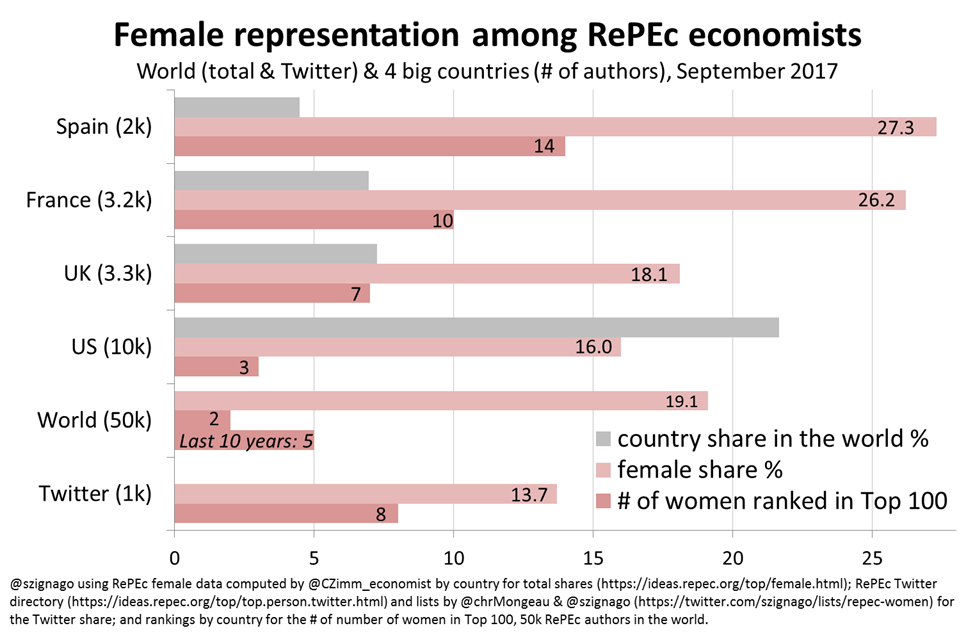
Thanks to the ranking of female authors in RePEc, we have long known the share of women in the RePEc sample of more than 50K authors: 19%. We now know also the shares of women economists by country, US state, field of study and PhD cohort. The following table shows for the largest countries their relative size and the proportion of women in each. European countries are doing better than the world average, especially Latin and Eastern European countries, while Anglo-Saxons are the most masculine (is it that relatively higher salaries for the profession in Anglo-Saxon universities attract the most competitive men?). Latin America is generally below average (except for Colombia and Argentina) while Asia has very low shaes of female economists, with less than 6% in Japan, China and India, and 9% in Pakistan (you can sort by column in the link).

The figures by cohort year of doctoral students in economics do not allow much optimism for the future, as shown in the graph below. In terms of fields of study, women are more present than before in all disciplines, but there are more masculine fields than others: finance (10.9% of women), time series (11.4%), sports economics (12.2%)… The most feminine: demography (37.7%), tourism (34%), Eastern economies (33.4%, likely due to the higher share of females in those countries).

IDEAS also lists the RePEc economists active on Twitter (over 1000 registered). While women represent 19% of the RePEc authors, they are only 14% in the Twitter subsample. Looking at the Top 25% of this list of RePEc/Twitter economists by number of followers (3rd row), the proportion of women falls to less than 13%. In fact, the total audience of these women among the top 25% is a little over 3%. The table also provides the names of the most followed female economists on Twitter: only eight are ranked among the top 100. The lack of women at the top is also apparent in the rankings based on the quality of publications and citations that RePEc releases: only two appear among the world’s top 100, Carmen Reinhart and since recently Asli Demirguc-Kunt. The following figure gives some statistics about the top economists in some of the countries with the most registered economists. Again, European countries outperform Anglo-Saxon ones in terms of women among the top 100.

There is a lot of literature documenting this gender bias in the economics profession. These latest RePEc data complement what is well known, allowing international, thematic and temporal comparisons. See also the nice interactive representation of the RePEc network that Christian Mongeau makes by gender.


RePEc in October 2017

November 5, 2017

A group of RePEc volunteers met last month in St. Louis and discussed for two days all sorts of issues. Over the next months, users will notice changes resulting from that meeting. For starters, we have


  1. reworked the conditions for the use of RePEc data,
  2. opened up some of our internal mailing lists to allow others to participate in the discussions,
  3. created a wiki for RePEc,
  4. opened a GitHub account,
  5. have now an official Twitter account.

Speaking of Twitter, we have now listings of economists on Twitter by country. In more regular business, we have counted 567,065 file downloads and 1,920,977 abstract views and welcomed the following new archives: Bank of Korea, Fondazione Luigi Einaudi, Journal of Mechanism and Institutional Design, National Bank of Ukraine, Gebze Technical University, Pontificia Universidad Católica de Valparaíso, and Universitas Gadjah Mada. As for the milestones we have reached, we have

2,400,000 listed items
4,000 books with extracted references
1,000 economists with linked Twitter account
125 topics on RePEc Biblio


St. Louis Fed hosted RePEc workshop

October 18, 2017

RePEc is volunteer-based, and those volunteers rarely meet. Yet, for the twentieth anniversary of the initiative, the St. Louis Fed sponsored a two-day workshop assembling most core-volunteers and some friends. The main topics of discussion were about contingency planning, both for hardware and people, modernizing our offerings, and recruiting a new generation of volunteers. The intensive meeting yielded some decisions that will become visible over the next months. In the meanwhile here is a group photo:

From left to right, standing: Christian Mongeau, Jose Manuel Barrueco Cruz, Bob Parks, Kit Baum, Jan Höffler.
Sitting: Douglas Hanley, Thomas Krichel, Areerat Kichkha, Soledad Signago, Mahdi Moqri, Christian Zimmermann.
Absent from picture: Genevieve Podleski, Dan Eubanks.
Participated remotely: Sune Karlsson, Bernardo Batiz-Lazo, Volker Schallehn, Jan Weiland, Sergey Parinov.


RePEc in September 2017

October 6, 2017

Academia is reawakening from its Summer slumber, and it shows on RePEc. We counted 441,497 file downloads and 1,657,039 abstract views, and we welcomed the following new RePEc archives: World Inequality Lab, Global Academy of Training and Research, VsI Entrepreneurship and Sustainability Center, Southern Voice, National Taiwan Ocean University. As for the milestones we reached, we have:

7500 ranked institutions
400 indexed book series
20 years of IDEAS


IDEAS turns 20

September 27, 2017

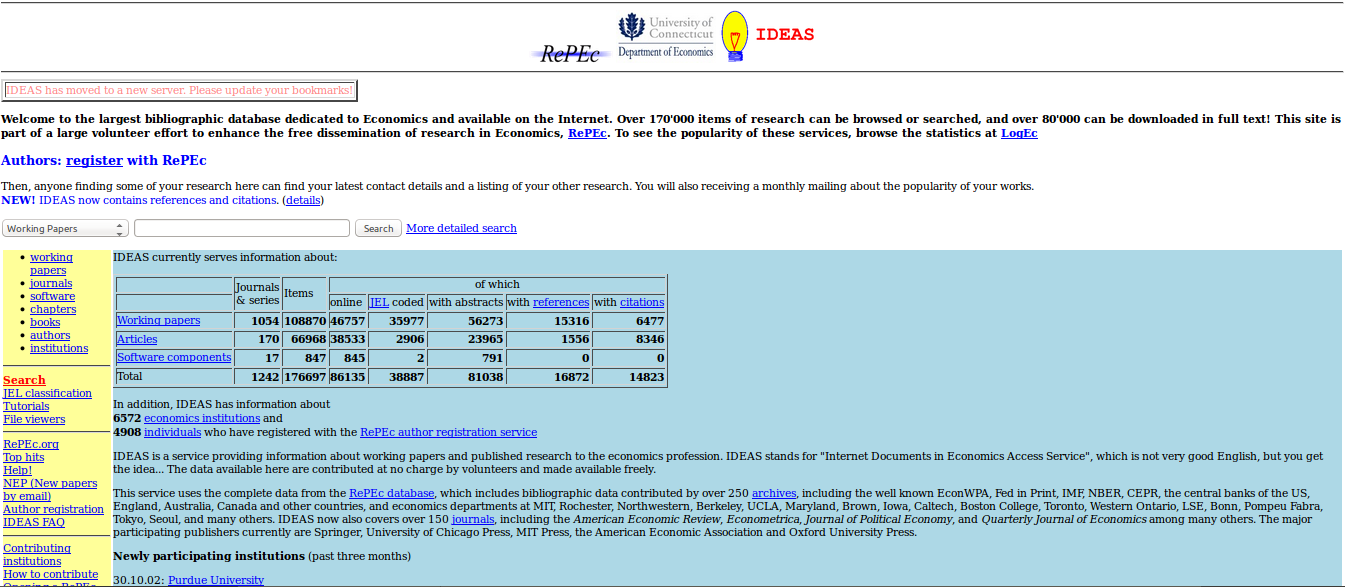
IDEAS just turned 20. Launched in September 1997 on a web server sponsored by Université du Québec à Montréal and adapted from scripts written for WoPEc by José Manuel Barrueco Cruz (who is now in charge of citation analysis at CitEc), the site initially displayed 40,000 papers and articles. Now, there are sixty times more documents. A screen shot from the early days is below.

In 2002, IDEAS moved to the University of Connecticut, followed by the Federal Reserve Bank of St. Louis, where it is still hosted. Over time, the site served 3.6 billion pages, although the vast majority where requested by web spiders for the major search engines and some page skimmers (who should really use the API). Once all this robotic access is cleared, the abstract pages alone where read almost 300 million times (or an average of 120 times for each listed item) and 70 million downloads were recorded (or an average of 31 times for each document available for download).

A few dates relevant for the history of IDEAS:


  • September 1997: IDEAS opens for business at the Université du Québec à Montréal
  • June 1998: the first ranking is published, covering abstract views for items and serials
  • August 2000: the first author ranking
  • February 2001: the first institution ranking
  • October 2002: IDEAS is now at the University of Connecticut
  • June 2011: IDEAS moves to the St. Louis Fed
  • January 2013: MyIDEAS is available
  • December 2014: IDEAS becomes mobile friendly


RePEc in August 2017

September 5, 2017

We are finally waking up from the Summer slumber. We have high expectations for the near future while relatively little happened lately on RePEc. We got four new participating archives: Scientific Publishing Institute, Joint Research Centre (Ispra), University of Ibadan, CAF Development Bank of Latin America. We counted 408,853 file downloads and 1,468,524 abstract views. We hope to report more next month.


Why linking to research on RePEc sites makes sense

August 30, 2017

If you participate in online discussions about economics research, if you have an online syllabus, or if you share some literature through email, you are likely providing a link to some full text on a publisher’s site. I want to argue here that it is a better idea to link to a RePEc service (abstract pages on EconPapers and IDEAS or links from NEP reports). The reasons are the following:


  1. Link to full texts go stale. RePEc URLs are permanent and contain updated links to full texts.
  2. If the full text link is gated behind a paywall, the RePEc link can still provide context and often a link to a free version.
  3. Alternatively, if the full text link is going to a working paper, a RePEc page may have a link to a version published in a journal.
  4. Clicking on a RePEc link will give the author(s) credit, this cannot happen if the link goes directly to the full text.
  5. A RePEc abstract page also provides related research (cites, references) and links to author profiles. The interested reader can thus explore for more.

EconPapers and IDEAS each have easy tools if you want to share a link through social media or email. Use them!


RePEc in July 2017

August 4, 2017

As usual, July is a calm month. We have to report a new web page detailing the representation of women in economics in various ways. We added only two new archives: Exeley and Step Academic. And we counted 401,303 file downloads and 1,537,997 abstract views. As for milestones, we have more to report:

1,500,000 listed journal articles
1,000,000 listed journal articles with abstracts
12,500 economists listed in the RePEc Genealogy


Why do some words look weird on RePEc sites?

July 27, 2017

When you browse through the various RePEc sites, you may come across some strange words or names, like González, su¢ cient or Möller. Why do those appear? To get to the bottom of this, one has to first understand how the RePEc sites get their content. All of it comes directly from publishers, about 2000 of them, who make all the relevant information available on their respective sites. To do so, they followed instructions and put files with a particular layout on their ftp or web sites.

These files are supposed to be simple text files, not formatted like they would be with Microsoft Word or LibreOffice. That should make them easy to handle with automated scripts. Unfortunately, this ignores the pesky issue of character encoding. Every operating system or software assumes that a particular character encoding is the standard, which is fine until a file moves from one computer to another. Early on, the files used in RePEc were assumed to be encoded as ISO-LATIN-1 or Windows-1252 by default. Back in 1997, UTF-8 (“Unicode”) was rare. Yet, there is till the option to force RePEc scripts to assume UTF-8 by adding at the start of the file a byte-order mark (“BOM”), which signals that the file has a non-standard encoding.

Now UTF-8 has become much more prevalent, and publishers sometimes put UTF-8 encoded data in files without the BOM, especially for files created by scripts. RePEc then interprets the data as ISO-LATIN-1 or Windows-1252, and the output can then look strange for any character that is outside the restricted ASCII set (simple letters and numbers). For example, any accented characters like é, ñ, ç, and ü will look odd if wrongly encoded. The same applies to ligatures like æ, ffi, and ß, non-Western alphabets, and some punctuation used in Microsoft Word.

As a RePEc publisher, how can you fix your poorly encoded UTF-8 data? There are two solutions. Either add the BOM at the start of the data, or use the new .redif extension which assumes UTF-8. But if you convert from .rdf to .redif, make sure to delete the old .rdf file(s), or your records will come up as duplicated and thus become invalid. And remember: no HTML encoding in your files.